
Can a Motor Perform at Its Original Efficiency After Rewinding?
A common question in industrial maintenance is:
“Can a rewound motor still perform at its original efficiency?”
With Malaysia’s MEPS 2027 efficiency standards approaching, understanding how rewinding affects performance is essential for both compliance and cost savings.
What Happens During Rewinding?
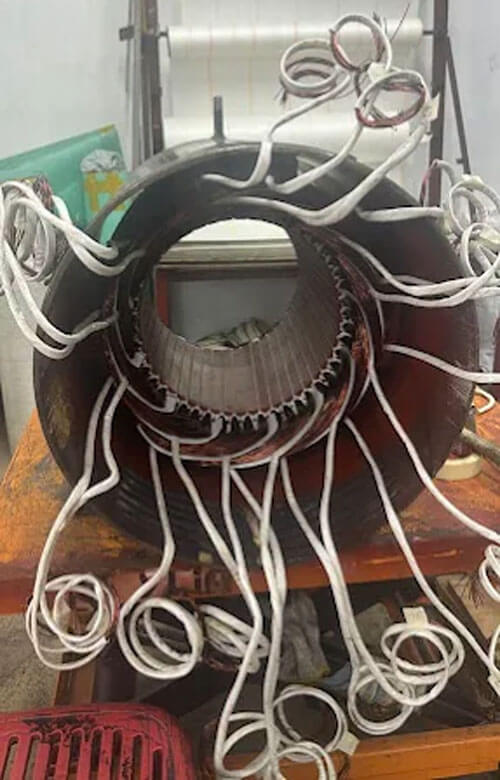
Rewinding involves removing damaged coils and replacing them with new copper windings while preserving the motor’s magnetic core. However, any deviation from the original design can influence performance:
Copper losses: Incorrect wire gauge or turns increase resistance.
Core losses: Overheating during stripping damages laminations.
Air-gap uniformity: Misalignment reduces magnetic flux efficiency.
Stray load losses: Improper coil pitch or slot fill affects harmonics.
Even small workmanship errors can slightly lower efficiency, especially on continuous-duty motors.
Research Findings & Best Practices
Independent studies by EASA and AEMT confirm that when proper rewinding procedures are followed, a motor can maintain or even slightly improve its original efficiency. Key requirements include:
Preserving original winding design and copper cross-section.
Testing core losses before and after stripping.
Ensuring correct insulation class and slot fill.
Completing full balancing, vibration, and PQ testing after assembly.
In short, efficiency loss results from poor workmanship, not the rewinding process itself.
With Suruhanjaya Tenaga’s MEPS 2027 in place, industries are encouraged to restore rather than replace motors whenever possible—provided the work is done by accredited workshops with proper diagnostic tools such as Motor Circuit Analysis (MCA), Power Quality (PQ), and vibration audits.
At TE Teras Tech , every rewound motor is verified through post-repair testing to ensure true efficiency recovery, not just mechanical operation.
When to Rewind vs Replace?
Situation Recommendation
1) Motor below 55 kW, minor winding damage ✅ Rewind – cost-effective and fast turnaround
2) Motor above 75 kW or repeated failures 🔁 Consider replacement – efficiency improvement opportunity
3) Stator or rotor core damaged or overheated ❌ Replace – performance cannot be restored
4) Rewinding needed for MEPS compliance ⚙️ Use accredited workshop with loss testing capability
Conclusion
A rewound motor can perform as efficiently as the original—if the work follows proper engineering standards and testing procedures. Skilled rewinding not only restores performance but also extends equipment life and supports energy-saving goals under MEPS 2027.
When efficiency, reliability, and sustainability matter, rewinding done right is the smarter choice.