
Bearing Failure Is Often the Symptom, Not the Root Cause Replacing the Bearing Does Not Solve Every Bearing Problem
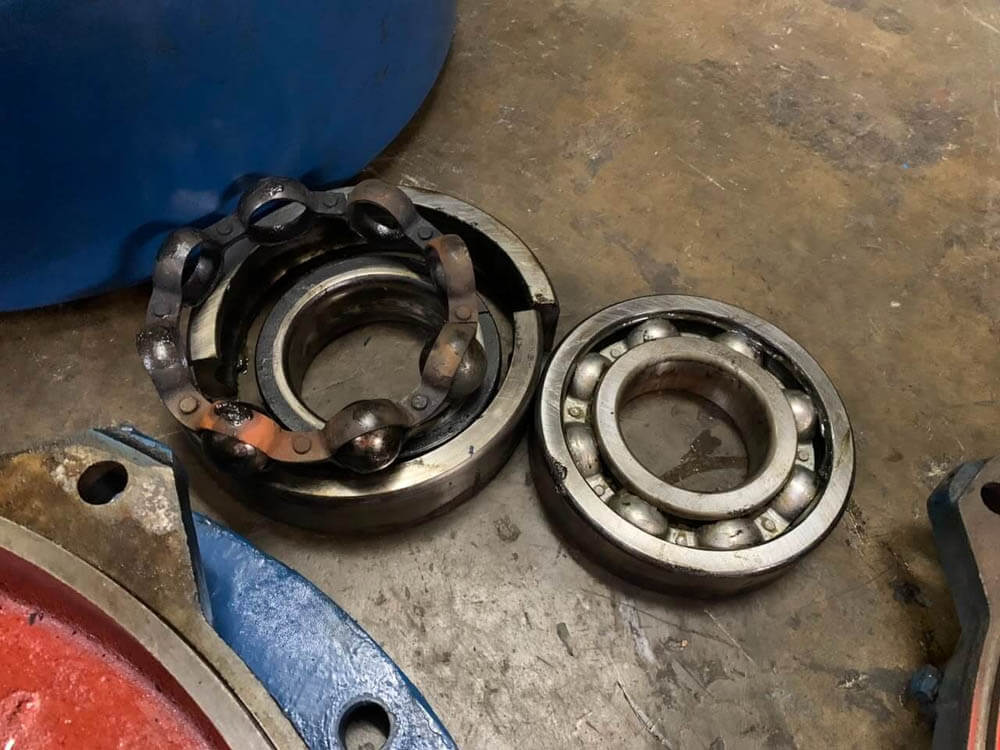
Bearing replacement is one of the most common repair activities in rotating equipment.
However, replacing the failed bearing without identifying the actual cause often results in repeated failures.
A proper Root Cause Analysis (RCA) investigates the mechanism behind the failure rather than simply replacing damaged components.
A Real Industrial Case
A newly installed 75 kW compressor motor returned after only three months of operation.
Inspection revealed:
- Drive End (DE) bearing completely seized.
- Non-Drive End (NDE) bearing also found with little remaining grease.
- Grease contamination around the stator winding.
- Abnormal shaft journal wear.
At first glance, the failure appeared to be a simple lubrication issue.
However, one important question remained.
How could a new motor lose its bearing grease within only three months?
Looking Beyond Lubrication
During the investigation, the bearing arrangement and mechanical design became important considerations.
Potential contributing factors included:
- Bearing arrangement
- Axial preload
- Coupling installation
- Wave washer location
- Shaft positioning
- Grease retention
Rather than treating lubrication as the root cause, the investigation focused on understanding why the grease had been displaced.
Engineering Corrective Actions
Corrective actions may include:
- Verifying coupling installation and axial positioning.
- Reviewing bearing preload and end float.
- Evaluating wave washer location.
- Improving assembly verification procedures.
These engineering controls help eliminate the root cause rather than repeatedly replacing failed bearings.
Conclusion
The failed bearing is often only the final symptom.
Effective Root Cause Analysis focuses on understanding how the failure developed, allowing maintenance teams to prevent recurrence, improve equipment reliability, and reduce long-term maintenance costs.