
Why Does a Blower Still Vibrate After Dynamic Balancing?
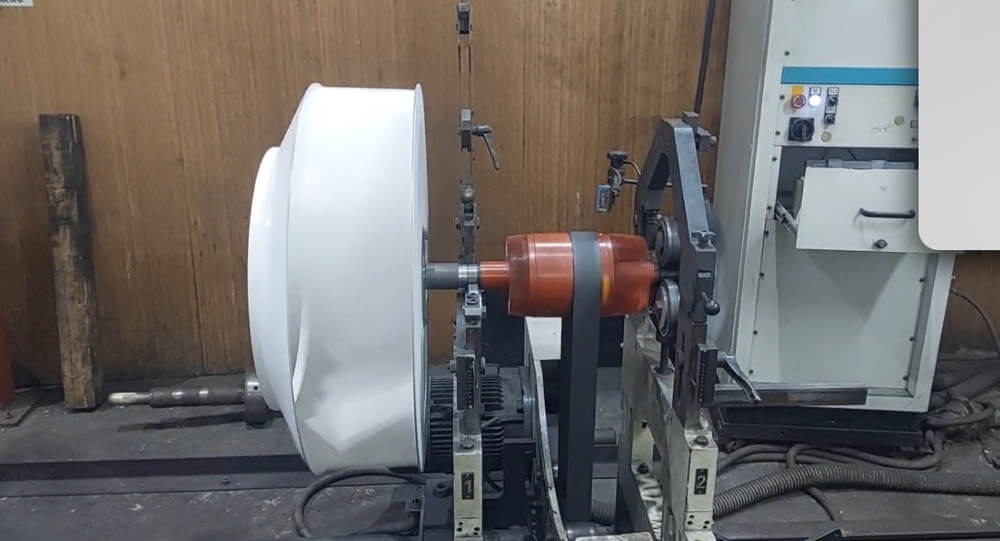
It is a common and frustrating situation in industrial maintenance.
Your blower wheel has passed dynamic balancing on the balancing machine. The balancing report shows an acceptable residual unbalance, yet after installation, excessive vibration is still present.
So, what went wrong?
The answer is that dynamic balancing alone does not guarantee vibration-free operation. In many cases, vibration is caused by factors beyond mass unbalance. Understanding these factors is essential for achieving long-term rotor reliability rather than simply obtaining a “PASS” result on the balancing machine.
Dynamic Balancing Solves Mass Unbalance — Not Every Vibration Problem
Dynamic balancing is designed to correct mass distribution so that the rotor’s centre of mass aligns with its rotational axis.
However, if the blower wheel itself is mechanically distorted or structurally compromised, balancing weights can only compensate for part of the problem. The rotor may still generate periodic excitation forces during operation, resulting in elevated vibration levels.
This is why balancing should always be supported by a comprehensive mechanical inspection before any correction weights are applied.
1. Verify Blower Wheel Roundness (Radial Runout)
One of the first inspections should be the blower wheel’s roundness.
A blower wheel that has become deformed due to handling, welding distortion, corrosion, or previous repairs may exhibit excessive radial runout. As the wheel rotates, the uneven geometry continuously excites vibration even if the mass distribution has been corrected.
Measuring radial runout with a dial indicator allows engineers to determine whether the wheel geometry remains within acceptable limits before balancing begins.
2. Verify Structural Flatness (Axial Runout)
Another frequently overlooked inspection is axial runout.
If the side plates or wheel structure are not perpendicular to the shaft axis, the blower wheel will wobble during rotation. This creates cyclic axial forces that cannot be eliminated by adding balancing weights.
Even a perfectly balanced rotor may continue to vibrate if excessive axial runout exists.
Therefore, verifying both radial and axial runout should be considered standard practice before balancing any blower wheel.
3. Single-Plane or Double-Plane Balancing?
Another common issue is selecting an inappropriate balancing method.
Many blower wheels are balanced using a single-plane balancing procedure simply because it is faster. While this may be acceptable for narrow rotors, it is often insufficient for wider blower wheels.
For double-plane blower wheels, double-plane dynamic balancing is generally the preferred approach.
By correcting unbalance at two separate correction planes, engineers can minimise both static and couple unbalance simultaneously. This results in:
- Lower residual correction weights
- Lower excitation forces during operation
- Reduced vibration amplitude
- Lower resonance peaks in the FFT spectrum
- Improved rotor stability across the operating speed range
Selecting the correct balancing strategy is just as important as the balancing process itself.
4. Overhung Blower Wheels Require Additional Consideration
Overhung blower wheels introduce another challenge.
Since the blower wheel is positioned outside the bearing supports, shaft deflection becomes a significant factor during operation. Even when dynamic balancing has been completed successfully, shaft flexibility and overhung loading can still generate vibration.
For these applications, static balancing should also be considered as part of the overall balancing strategy to achieve the best rotor condition.
Balancing should always match the rotor design rather than applying the same procedure to every machine.
Engineering Before Balancing
Professional balancing is not simply about attaching correction weights until the balancing machine displays an acceptable result.
A proper engineering approach includes:
Visual inspection of the rotor
Verification of radial runout
Verification of axial runout
Assessment of rotor geometry
Selection of the appropriate balancing method
Dynamic balancing verification
Final vibration verification after installation
Only by considering the complete rotor system can engineers consistently achieve low vibration levels and long-term equipment reliability.
Conclusion
Dynamic balancing is an essential part of rotating equipment maintenance, but it is only one component of a successful vibration reduction strategy.
Rotor geometry, structural integrity, balancing method, shaft configuration, and installation conditions all contribute to the final vibration performance of the machine.
At TE Teras Tech Electrical Works Sdn. Bhd., we believe balancing should not stop at achieving a “PASS” result. Every balancing project is approached from an engineering perspective, combining rotor inspection, root cause analysis, and appropriate balancing strategies to deliver reliable long-term performance.
The best balancing job isn’t the one that passes the balancing machine. It’s the one that stays vibration-free in the field.